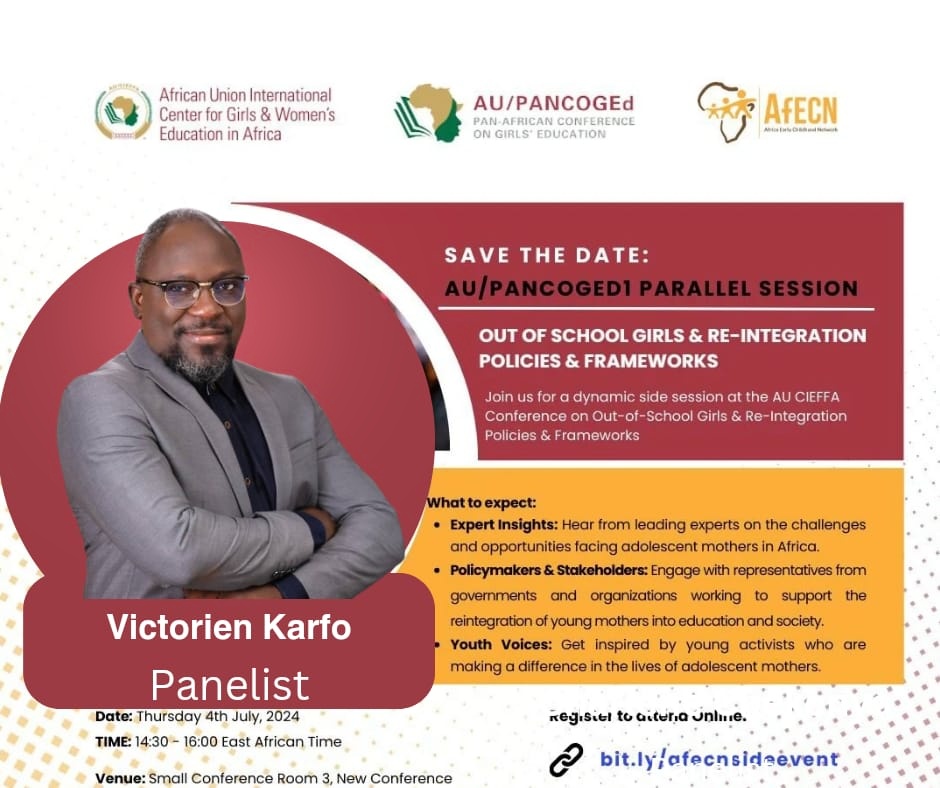
From 2 to 5 July 2024, the African Union brought together at its Addis Ababa headquarters the very first Pan-African Conference on Girls’ and Women’s Education (AU/PANCOGEd1). Organised by the AU International Centre for Girls’ and Women’s Education in Africa (AU/CIEFFA), it was held under the theme « Prioritising girls’ and women’s education: a strategy for increased access to inclusive, lifelong, quality and relevant learning in Africa ». Around 600 participants attended in person and 300 online, including Ministers of Education and Gender from many African countries.
A session on out-of-school girls and adolescent mothers
On 4 July, I was a panellist in the parallel session « Out-of-School Girls & Re-Integration Policies & Frameworks », organised by the Africa Early Childhood Network (AfECN) with AU/CIEFFA.
The starting point is simple: a teenage girl who becomes a mother very often leaves school to care for her child. Yet the African Charter on the Rights and Welfare of the Child requires States to let girls who become pregnant continue their education. One of the main barriers remains the lack of affordable, quality childcare.
The session presented the findings of a continental study commissioned by AfECN on the situation of adolescent mothers in Africa, then gave the floor to policymakers and young practitioners. It was moderated by Nyasha Chingono, AU/CIEFFA youth alumna, with AfECN consultant Maria Mdachi.
My contribution
I joined remotely from Burkina Faso. I had been asked to present the situation of schoolgirls who become mothers and drop out. Every speaker before me had given figures. I chose not to: figures remain figures, they do not change the life of a single girl.
First, I described a reality that statistics do not show. Here, a girl who becomes pregnant is often driven out of her family, on the grounds that she brings bad luck. She loses her home, her support and her schooling all at once.
Then I shared what we did at the centre I run, with our own funds. We took in pregnant girls and young mothers. Some attended classes throughout their pregnancy. For the others, I looked after their babies myself while they were in the workshop. That is how they were able to complete their training.
Finally, I challenged the participants: how many of us can tell stories like these? Analysing the problem from a conference room is not enough. If each of us gave a little of our salary, or skipped a few dinners, abandoned girls could be back in class tomorrow.
Key takeaways
- Re-integration cannot simply be decreed: without childcare, a young mother cannot return to school or training.
- Policies exist in several countries, but implementation remains uneven; re-entry policies must not stigmatise girls.
- Vocational training and apprenticeships must be part of second-chance solutions.
The conference closed with a Call to Action endorsed by 35 African Union Member States.
Why it matters for my work
At the CFPC, we train vulnerable young people, including young women, free of charge to national certification. This session strengthened my conviction: including girls means designing programmes around their reality, including when they are already mothers.
Do you want job and training programmes built around the reality of young women, including young mothers? See my service Work in fragile settings and let’s talk.